There are many times when as Christians we place more faith in the process than in the one who directs the process. We may even chose one aspect over another, thinking that this will bring more security for us. Today’s watchword challenged us to examine what drives our faith and points us to what truly matters. ‘Fear God’. For in many dreams and in many words there is emptiness. Rather, fear God. Ecc 5: 7
The watchword speaks to a specific situation. One in which the religious practice of the day was to place a lot of faith on dreams and long speeches. The person who is superstitious will place great value on dreams and may even adjust their lives accordingly. The verbose person, quick to make vows, will be contented in thinking that their long and articulate prayers are pleasing and acceptable to God. In both cases God is second place. We must be careful that we do not fall into the trap of placing God second to superstition or to self. When self is first, dreams and words are powerless to help us. It is not what we or others say or believe that matters most. It is not how we present ourselves before others and God that counts, it is how much we fear God.
To fear God is to be in awe of God, to give the respect, the honor to God that is due only to God. To fear God is to be in complete submission to God, realizing that our will and desire leads to bad choices, but God leads us constantly to what is best for us and those around us. Proverbs 9: 10 reminds us The fear of the Lord is the beginning of wisdom.Someone stated it this way ‘the fear of the Lord is the beginning of wisdom and wisdom is to depart from evil’. God created us for this purpose because it in in fearing God that we are able to truly worship him with all our heart, soul, body and mind. Ecc 12: 13 -14 tells us that our complete duty is to fear God and obey his laws for God will bring all our actions into judgement, both good and bad. I urge you friends, do not put your trust in the things of the world, as beneficial as they may seem. Do not trust in popular religion, attractive though it may be. Rather keep your faith in God intact and depend on God only.Trust nothing and no one more than you trust God. In all that we do let us remember first and foremost to fear God. Amen.
The Lord your God is testing you, to know whether you indeed love the Lord your God with all your heart and soul. Deuteronomy 13:3
Hear the context of today’s Watchword: “If prophets or those who divine by dreams appear among you and promise you omens or portents,and the omens or the portents declared by them take place, and they say, “Let us follow other gods” (whom you have not known) “and let us serve them,” you must not heed the words of those prophets or those who divine by dreams; for the Lord your God is testing you, to know whether you indeed love the Lord your God with all your heart and soul.”(vs 1-3)
The text outlines that dreams can be from God, or they can be false prophesies. We should allow God to bring confirmation to any dream we believe brings a message from him. Interestingly, this text is not focused on a prophet who speaks a word and it does not come to pass. Rather, it is about a prophet who speaks a word and it comes to pass, but then say that they should follow other gods and serve them. For Moses, such prophets and dreamers should be ignored.
What is critically required here is discernment. In this age where popularity and falsehood are the order of the day in Christendom, Christians cannot neglect the importance of discernment. The reality of signs and wonders can never be the only evidence of truth or the revelation by God. Indeed, those who are immediately convinced at the sight of supernatural power or reality are in danger of great deception. Godly discernment will always carefully examine the message of a prophet or dreamer, instead of the spiritual experiences which he or she perform. No prophecy can be true if it speaks against what God has already revealed in his word.
We are reminded of John’s admonition, “Beloved, do not believe every spirit, but test the spirits, whether they are of God; because many false prophets have gone out into the world” (I John 4:1). No matter how impressive or accurate a prophet’s miracles or prophecies, his credibility hangs on whether he leads people toward or away from God. For Richard Ritenbaugh, the following questions must be answered before we judge a person as a true or false prophet:
1. Does he claim to prophesy in God’s name or in a false god’s name?
2. Do his prophecies come to pass?
3. Does he teach the truth based on God’s Word?
Yet, Moses points out that all this is a test for God’s people to determine the sincerity of their allegiance to God. God allows deceivers to exist among his people so as to allow the hearts of his people to be tested and proven, to see if they really love the God of truth or are merely seeking a spiritual sign or experience. This forces us to ask some serious questions – Why do we really serve God? What is our motive for following God? What benefits are we seeking? Are we seeking wonders and signs, prosperity and blessings? May we be reminded that God will ultimately separate those who are true from those who are not, and each of us will receive our just reward.
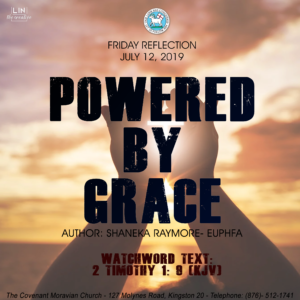
He saved us, and called us with an holy calling, not according to our works, but according to his own purpose and grace, which was given to us in Christ Jesus before the world began,
2 Timothy 1:9 KJV
https://bible.com/bible/1/2ti.1.9.KJV
Greetings, peace from God the Father, I hope you are in good health and prospering in the GRACE of our Lord and savior, Jesus Christ.
I share with you the commentary on the word for today. Matthew Henry puts it this way:
“The origin of salvation is the free grace and eternal purpose of God in Christ Jesus. If we had merited it, it would have been hard to suffer for it; but our salvation by it is of free grace, and not according to our works.”
In my own words, it is not of good that we have done, but we are called to serve ONLY because God has given to us the free gift of Salvation. It is through him that we are POWERED BY GRACE
As I reflected on the text , I began to wonder whether we truly appreciate and understand the mission to which we are called. I wonder if we recall the reason for which we are called. I wonder if we are cognitive of the fact that we are called by God. I also wonder why we “work” so hard thinking that our works will carry us into eternity!
Paul in his letter to Timothy, belabored 3 very important points:
1. It is God who saved us:
2. We are called to a Holy calling:
3. It is ONLY by GRACE that we receive the FREE gift of salvation:
I want us to pay keen attend to these three pronouncements. None of the above requires human input. For this reason I urge you to keep your hearts and minds stayed on Jesus. It is easy to get caught up in the WORK of the church, it is easy to become self righteous and to act has though we are POWERED by our own doing rather that by GOD’S GRACE.
Brothers and Sisters, my beloved friends, do not be ignorant of the gospel. Instead , let the word of God sit with you day and night, that you may understand why you are here and what you are meant to do. Do not be ashamed of the admit that you are not powered by your own skills and competencies, but be bold in declaring that you are POWERED BY GRACE!
Paul is by far the most resolute apostle in history. He warns against self gratification and self righteous. He embraces the free gift of salvation. He speaks of the GRACE of God in ALL his teachings. If you won’t take it from me , take it from him.
Untill next week, remember it is not works that saves, keeps and satisfy Instead, it is the GRACE OF GOD.
Jesus said, “The kingdom of heaven is like a mustard seed that someone took and sowed in his field; it is the smallest of all the seeds, but when it has grown it is the greatest of shrubs and becomes a tree, so that the birds of the air come and make nests in its branches.
Matthew 13:31-32
As I reflected some more and did further readings on this New Testament text used for reflection on Monday, many thoughts began to consume me. I felt led to share some more thoughts on this text. Jesus indicates that the mustard seed grows into the greatest of shrubs and unnaturally becomes a tree. Indeed, it is the simplicity of the gospel that produces exponential growth. The spread of the gospel began like a humble, lowly plant, yet with a powerful, pervasive, penetrating and pungent effect. The church has grown like a great shrub and tree.
Yet, I believe that there is a word of caution here. There are aspects of the church that have grown into a huge, ungainly, abnormal tree, concerned with power, pride and domination, wanting to be served instead of to serve. Too many churches have become more concerned with putting up great, imposing church buildings as a sign of our prestige and status in the community. We want to create an image that sells like secular businesses, and we become consumed with advertising and publicizing ourselves to keep ourselves before the eyes of the world. We crave for power and pursue setting up empires, instead of building the Kingdom. I think that sometimes the way the gospel is proclaimed we forget that the church doesn’t save anybody; the Lord does. The church doesn’t help anyone; it is the Lord who helps through us. We sometimes forget the Lord and talk more about our church. Look again at the early Christians, they never mentioned the church until after a person joined the family of God. They talked about Jesus.
Jesus also states that ‘…the birds of the air come and make nests in its branches.”What does this mean?Ray Stedman points out for us that right in this series of parables, Jesus tells us what the birds mean. In the first parable he said that when the seed of the word falls upon a hardened human heart, the birds come and snatch it away. The birds represent the evil one, the enemy, whose evil powers and forces are at work upon people’s lives. For Stedman, “… vultures and buzzards, birds of prey, apt symbols of evil persons and evil ideas make their home right in God’s church.” One of the ways that this is demonstrated is where preachers and spokespersons for the church propagate a flood of stupid, ridiculous, mixed-up ideas. These are evil concepts which have blasted, blighted and even ruined the hearts and minds of people. We must wake up, discern right from wrong, and ban anything that is not truth from our pulpits and worship services. Too many Christians have fallen asleep while seeds of falsehood are being sown and producing evil plants and fruits. IT’S TIME TO WAKE UP!!!
Till next week, may a fresh anointing fall on us as we build God’s Kingdom.
Jesus said, “The kingdom of heaven is like a mustard seed that someone took and sowed in his field; it is the smallest of all the seeds, but when it has grown it is the greatest of shrubs and becomes a tree, so that the birds of the air come and make nests in its branches. Matthew 13:31-32
Today’s New Testament text records the third of five parables which Jesus shared about the Kingdom of heaven. These were all given in one message delivered on a single occasion as he sat in a boat on the Sea of Galilee teaching the people gathered on the shore. He interprets the first two for us as a guide to our own interpretation of the rest. It is clear from the first two that every element in the story has significance.
In this parable five symbols are used. There is the sower again, and the field in which he sowed, and the seed that is sown which in this case is mustard seed, the tree which grows from it, and the birds that make their nests in its branches. It is easy to interpret the first two symbols. The sower obviously is Jesus himself. In each of these parables he has been sowing, and in the second parable he told us, “The sower is the Son of man.” The field is the world. In this case a mustard seed is sown. The use of these various seeds is Jesus’ way of revealing the various aspects of the gospel which he turned loose in the world. He sowed a fantastic, revolutionary, radical word in human society.
Mustard is a peculiar kind of seed with an unusual quality. It was known to be an irritant, something fiery and biting. Jesus uses this symbol to indicate that the message of the kingdom of God is intended to be arousing, yet irritating among people. Turn it loose, and it will get a whole community excited, stirred up, either negatively or positively. The gospel makes us uncomfortable at times. We sometimes experience the mustard working in and on us as we begin to squirm and itch, or experience transformation and healing.
Jesus points out that this mustard seed is the smallest of all seeds. A mustard seed is small, but obviously not the smallest of all seeds. I believe that Jesus was using a proverb of the day, “small as a mustard seed”. Here he is clearly stressing the apparent insignificance of the gospel. It does not look like much; it does not sound like much. We say, “Believe on the Lord Jesus Christ, and you will be saved.” That does not sound very impressive to many people. It is so simple that you can teach it to children and they understand. So the world is not very excited about it; the world does not regard it as a tremendous, earth-shaking philosophy. The gospel is simple. But, let someone actually believe it, and see what happens. When we really trust Christ and invite him into our lives, it is the most transforming, the most revolutionary thing that could ever happen. It is the beginning of a radical change.
This is the seed our Lord is talking about. This message of the kingdom is like a seed of mustard planted in the midst of society, with fantastic power. Look at the tree that grows out of it! Yet mustard is not a tree; it does not grow into a tree. What in the world is Jesus saying then? I believe he intends to teach that growth in the kingdom is an unnatural growth. When Jesus is our Lord, he takes away pride, destroys egotism and self-centeredness and renders a person humble and gentle toward others, ready to serve. Real growth is in surrender and service and not in domination, pomposity and power. It is the inward working of the Holy Spirit that reflects itself in humble service on the outside.
Till next week, may we be enabled to experience the mustard effect!
Outside of God, there is NO life, just mere existence
The word for today:
‘For in him we live and move and have our being.’ As some of your own poets have said, ‘We are his offspring.’
Acts 17:28 NIV
https://bible.com/bible/111/act.17.28.NIV
Good day friends,
Blessed Friday to you all…
If a person is living and not merely existing that means he/she is spending life conveniently. However, Living is to make the most of life and to experience the beautiful reality of life as it is.Living means the actual existence of a being up to the fullest
Are you living or are you merely existing? This a question that each of us should ask ourselves. The answer to this question is heavily dependent on a number of factors, of which I will share only two. The two I find most important comes out of today’s text for reflection:
1. Outside of God, there is No life In verses 25 -27of this same chapter, Paul exclaimed why outside of the true and living God there is no other God. He went on to establish the foundation of our lives and explained that it is God who gave us life. Brothers and sister these words speak for themselves, if it is God who made us and gave us life, outside of him, WE HAVE NO LIFE!
2. We should know to whom we belong I invite you to read the entire chapter as to get a clearer understanding of why Paul said “it is in God we live, move and have our being”. However, I will say to us today, that it is important to know where you are from and to whom you belong.
Society teaches us that this is how we form our Identity and begin to learn more about ourselves. So I say to you friends, be clear about who you are and who you belong to. Otherwise, you will find yourself in the same position as the people mentioned in this passage. They were worshipping UNKNOWN GODS! . THEY HAD NO IDENTITY!
Untill next week, remember, outside of God there is no life, you are just merely existing
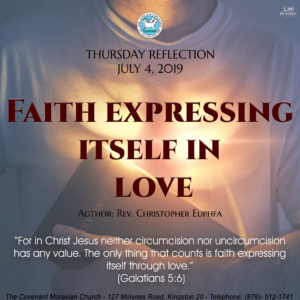
“For in Christ Jesus neither circumcision nor uncircumcision has any value. The only thing that counts is faith expressing itself through love.” Galatians 5:6
Greeting friends!
Today’s reflection takes us to Galatians chapter 5 and more specifically verse 6. We are more acquainted with this chapter, because it speaks about the fruit of the Spirit and the works of the flesh, however it is the discussion that took place earlier in the chapter that led up to these popular verses. The discussion begins with freedom. At that time there were persons arguing that circumcision was needed in order to be saved, however Paul countered that argument by stating that Christ’s death and resurrection has set us free from the bondage of the Jewish law. This freedom does not mean we are free to do whatever we want. So, we cannot use it to gratify the sinful desires of the flesh. Instead we must use this freedom to serve another in love. Verse 6 summarizes beautifully this text, “For in Christ Jesus neither circumcision nor uncircumcision has any value. The only thing that counts is faith expressing itself through love.”
As I examined this text, I began to reflect deeply on this verse. Paul was addressing a misnomer created by Christians who believe that circumcision is the most important thing in salvation. These Christians began to confuse others (verse 7) by focusing on the non-essential. It makes me wonder how often we focus on the non-essential within our own churches… and how often do we allow these non-essentials to take priority over what is truly essential? What is the non-essential? This is anything that is not crucial to your faith in God and the salvific process. So when we argue about the length of service this is a non-essential. If we make it to heaven we’ll be praising God for the rest of our lives. Whether we paint the church in white or blue is a non-essential. Whether we cover our head or not in church is a non-essential. The use of the litany every Sunday is a non-essential. If you use it that is okay. If you don’t use it that is still okay. I doubt you’ll go to hell for not using it.
What is important though is faith expressing itself in love. I share the commentary on this verse from the New Living Translation. “We are saved by faith, not by deeds. But love for others and for God is the response of those whom God has forgiven… Because faith expresses itself through love, you can check your love for others as a way to monitor your faith.” We know that we are saved by grace for it is a gift from God, but we accept this gift through our faith. Now as a result of this acceptance we are required to demonstrate our love for God and our love for others. THIS IS WHAT IS CRUCIAL TO THE SALVIFIC PROCESS. Anyone who does not love does not know God for God is love (1 John 4:8). If we say we love God, but do not love others then we are a liar and the truth is not within us (1 John 4:20).
How we treat God and others is what is truly important. So we cannot say we love God, but we run the beggar that comes to church every Sunday. We cannot say we love, but our focus is only within Church and there are people within the community that need help. We cannot say we love, but there are those who have not heard the Good News of Jesus. We cannot say we love, but we look down on others or speak maliciously of them. We cannot say we love God and speak down to others and mistreat them, because you’re in a better position than they are.
I charge us not to make the non-essentials a priority; instead let us focus on the essential and show love to everyone. In the words of Shaneka Raymore-Euphfa “Love is an action word” so let us do it.
Until next week remember faith expressing itself in love is truly what is important.
Teach us to count our days that we may gain a wise heart.Psalm 90:12
Arthur Jackson writes, “Psalm 90 is a worshipful conversation Moses has with God. The superscription reads, ‘A prayer of Moses, the man of God.’ But even if we weren’t alerted that this psalm is a prayer, the language and tone clearly indicate the psalmist was talking to God. This prayer was spoken during a rough period in Israel’s history. It appears the people of God had experienced discipline (vv. 7–11, 15), which prompted Moses to talk to God about the brevity and fragility of human life in view of God’s eternal nature (vv. 1–6).” The psalmist makes several references to time, such as generations, years, days, morning and evening. For Jackson, “…tough times can compel us to talk to the Lord about our brief time on earth and appeal to Him for His help. They can also cause us to ask who may need the gift of our time.”
There is an African proverb that says, “Westerners have watches. Africans have time.” How many times have we said, ‘I don’t have time’ or ‘I can’t find the time’? It seems as if our very busy schedules and many deadlines to meet is dominating our lives. We seem to not even have time for ourselves. In the midst of all this, Moses prays in today’s Watchword, ‘Teach us to number our days, that we may gain a heart of wisdom.’ Paul writes, ‘Be very careful, then, how you live . . . making the most of every opportunity, because the days are evil’ (Ephesians 5:15–16).
Bill Crowder shares that he suspects that Paul and Moses would agree that our wise use of time isn’t just a matter of clock-watching. For Crowder, ‘The situation may call for us to keep a tight schedule—or it may compel us to give someone an extended gift of our time. We have but a brief moment to make a difference for Christ in our world, and we need to maximize that opportunity. That may mean ignoring our watches and planners for a while as we show Christ’s patient love to those He brings into our lives. As we live in the strength and grace of the timeless Christ, we impact our time for eternity.’
We are urged to be mindful that our time is limited so we have to make use of every time we have. Yet, we are challenged to recognize that what some people desire most from us is not our money or other physical possessions, but our time. Our time to give them a listening ear, our time to empathize with them, our time to extend a word of encouragement. This may be our greatest gift to others. God has given us all the time we need to fulfill all that he has given us to do.
Till next week, let’s remember that time management is not about clock-watching, it’s about making the most of the time we have.
Lord, do not let my heart be drawn to what is evil. Psalm 141:4
David’s prayer is indeed one that is often on our lips, as we pray The Lord’s Prayer “Lead us not into temptation, but deliver us from evil.” It is a thought that many times we struggle with, hoping to stay on the narrow way. But David prays that he would be not be drawn to temptation. He asks God to protect him from every form of temptation, for godly correction that may continue to live the holy and sober life that we have been called to live.
Hear Psalm 141:3-5 from the Message Translation
“Post a guard at my mouth, God,
set a watch at the door of my lips.
Don’t let me so much as dream of evil
or thoughtlessly fall into bad company.
And these people who only do wrong—
don’t let them lure me with their sweet talk!
May the Just One set me straight,
may the Kind One correct me,
Don’t let sin anoint my head.
I’m praying hard against their evil ways!”
David’s earnest intention is that he would not fall into the trap of sin, and it is a prayer that we all would share as believers. We know, that the devil is as a roaring lion, seeking whom he may devour but David asks God to guard his thoughts, his words and his actions so that he may never ever yield to temptation.
My brothers and sisters, we will be tempted. In fact, Christ himself was. The sin is not being tempted, it is in yielding to the temptation. Christ was tempted but never fell to temptation. So, we guard our hearts against actions that are contrary to God’s standards and his will and purpose for our lives. But it’s not just saying, we need to yield to God, to his Holy Spirit to guard us against the wiles of the devil. David prayed as he asks God to help him, to guard him against temptation. We need Jesus on the inside, working on the outside to bring about that change in our lives.
Then my brothers and sisters, we strive to live as children of God. Paul puts it this way “You are dead to sin and alive to God.” (Romans 6:11) And you, may ask, how then do we do that? The Apostle Paul gives an answer to that question in Romans 6: 12-14 (MSG) “That means you must not give sin a vote in the way you conduct your lives. Don’t give it the time of day. Don’t even run little errands that are connected with that old way of life. Throw yourselves wholeheartedly and full-time—remember, you’ve been raised from the dead!—into God’s way of doing things. Sin can’t tell you how to live.” We then have the power through Christ Jesus to be dead to sin and alive to God. David’ prayer is a request that he be so guarded so as to not slip. Not by his thoughts, his deeds or his lips. Then David in the latter text of Psalm 141 (MSG) writes;
“But God, dear Lord,
I only have eyes for you.
Since I’ve run for dear life to you,
take good care of me.
Protect me from their evil scheming,
from all their demonic subterfuge.
Let the wicked fall flat on their faces,
while I walk off without a scratch.”
Fix your eyes on Jesus on not on the things of this world. Keep focused on the things that are true, the things that are honest, the things that are just, the things that are pure, the things that are lovely, the things that are of good report; where there is virtue, or where there is praise. (Philippians 4:8) James says “Submit yourselves, then, to God. Resist the devil and he will flee from you.” (James 4:7)
Until next week, let our prayer be like David, “Lord, do not let my heart be drawn to what is evil.” May our song be “Jesus be a fence all around me, every day. “We cannot on our own, live this Christian life so let’s invite and allow Jesus to indwell us to show us the way. I leave with you today’s doctrinal text “Do not be overcome by evil, but overcome evil with good.” (Romans 12:21) Then we can say with every authority “Get thee behind me Satan.”
Who is wise and understanding among you? Show by your good life that your works are done with gentleness born of wisdom. James 3:13
Wisdom? What is that? While there are many persons who walk around boasting about how wise they are, there are some who struggle to come to grips with what it means to be wise. The latter becomes real when we reflect on the many foolish thoughts and ideas that we have had; the many foolish words we have spoken; the many foolish things we have done. Some of us wonder whether we can claim any measure of wisdom. I have always believed that wisdom is grounded in knowledge; there is no wisdom without knowledge. Wisdom therefore is the capacity to use knowledge appropriately.
The straight-shooter James clarifies for us what wisdom is and outlines that there are two kinds of wisdom. Hear him in chapter 3: 13-18:
13 Who is wise and understanding among you? Show by your good life that your works are done with gentleness born of wisdom. 14 But if you have bitter envy and selfish ambition in your hearts, do not be boastful and false to the truth. 15 Such wisdom does not come down from above, but is earthly, unspiritual, devilish. 16 For where there is envy and selfish ambition, there will also be disorder and wickedness of every kind. 17 But the wisdom from above is first pure, then peaceable, gentle, willing to yield, full of mercy and good fruits, without a trace of partiality or hypocrisy. 18 And a harvest of righteousness is sown in peace for those who make peace.
For James, when it comes to wisdom:
1. It must be shown by our good life – Wisdom is not hidden or kept a secret, suppressed nor buried. Wisdom is shown, more so revealed by and in the way we live. We need not declare to anyone that we are wise, it will be seen.
2. Our works must be done with gentleness – Those who are wise are not arrogant and boastful, but humble and gentle. This gentleness recognizes that others may not be as mature and developed as we are. In any case, the wise know that all that we are and all that we have is because of the manifold grace of God. The wise are disciples of Christ who walk alongside others and help them to grow and mature in Christ.
3. The signs are the Fruit of the Spirit – James distinguishes the earthly, unspiritual and devilish kind of wisdom from the heavenly and godly. The former may be described as the works of the flesh, while the latter is the fruit of the Spirit. The truly wise are those who bear the fruit of the Spirit in their daily lives, including love, joy, peace, purity, gentleness, willing to yield, mercy, impartiality and honesty. True wisdom comes from God and is dispensed by God in differing measure to whom he chooses.
As we pursue wisdom, a good place to begin is to join with David in today’s Watchword, “Search me, O God, and know my heart; test me and know my thoughts.See if there is any wicked way in me, and lead me in the way everlasting”Psalm 139:23-24