Header Image - From Ruins to Renewal: God at Work among His People

Thursday Reflection – August 22, 2019

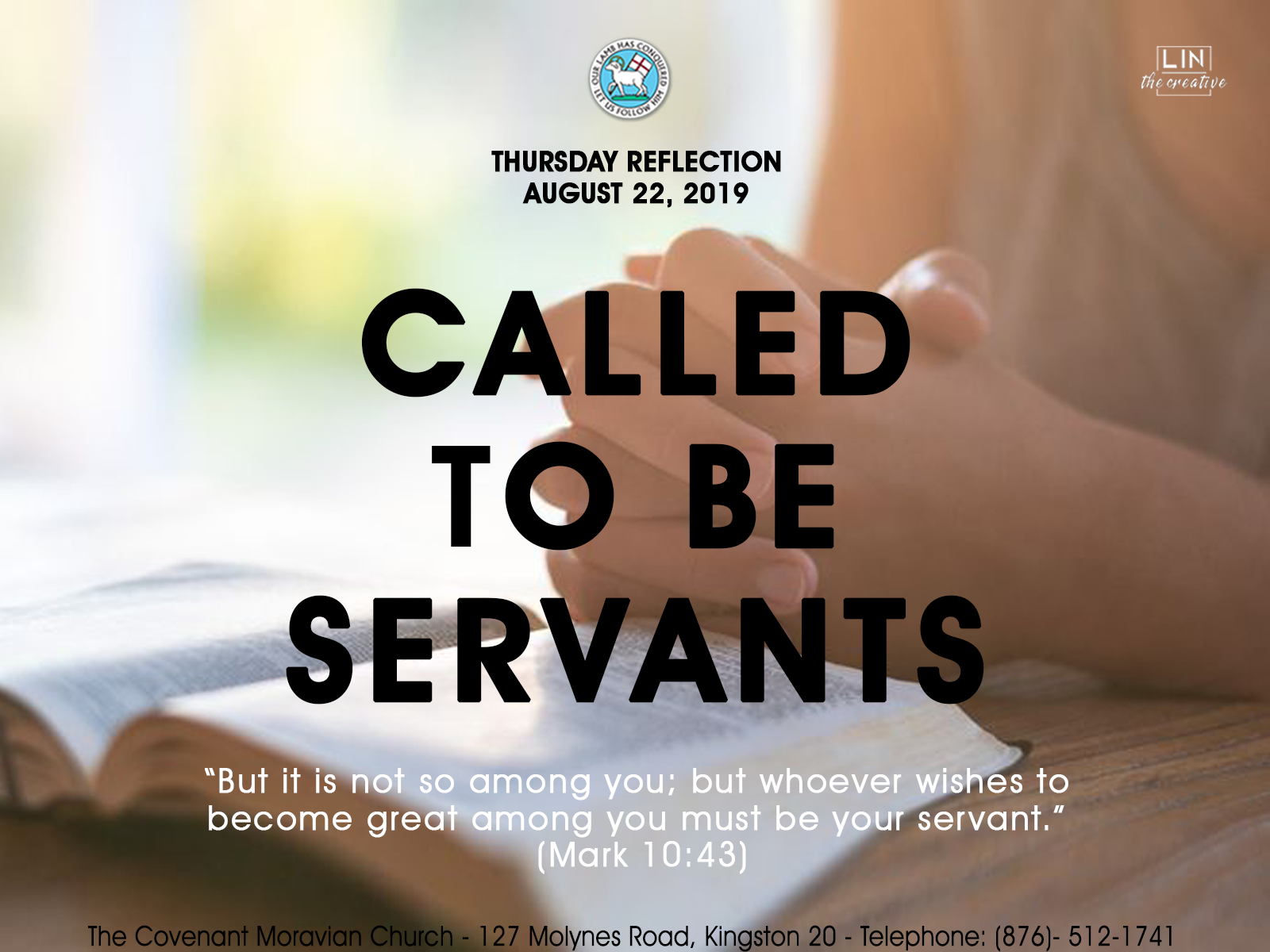
CALLED TO BE SERVANTS

But it is not so among you; but whoever wishes to become great among you must be your servant. Mark 10:43

Jesus was on his way to Jerusalem for what would be the fulfilment of his ministry here on earth. He was accompanied by his disciples who followed him until they were scattered after Jesus’s arrest in the garden of Gethsemane. On the way to Jerusalem James and John, the sons of Zebedee, asked to be placed on the right and left of Jesus when he enters his glory. Jesus indicated that he was unable to grant such a request for those places have already been reserved.

When the rest of disciples heard this they became angry with James and John for making such a request. Jesus then called his disciples to teach them. He said, “You know that among the Gentiles those whom they recognize as their rulers lord it over them, and their great ones are tyrants over them. But it is not so among you; but whoever wishes to become great among you must be your servant, and whoever wishes to be first among you must be slave of all. For the Son of Man came not to be served but to serve, and to give his life a ransom for many.”

At the heart of James and John’s request and the vexation of the disciples was self-centeredness, greed and a desire for power. James and John were only concerned about themselves and the disciples were upset that they were not part of this request. Jesus went on to explain that this is how the Gentiles or the world operate. They “lord” it over others and become tyrants in doing so.

In other words they crave power and want to be greater than others and in doing so ensure they subjugate others. They keep others down so that they can remain on top. They mistreat others so that they can be in control. They lie, scheme and plan so that they will always have subordinates. This is how the world thinks. They possess the mentality suggesting, “I am bigger, better, and have more power than you, while telling others you’re weak, insignificant and powerless.”

Humans generally have a desire to be better than others and this is evident in how leadership treat staff at times; how individuals in higher social strata treat those in lesser social strata; how the rich treat the poor and how the poor treat those who are poorer.

Jesus said to his disciples, “But it is not so among you.” As believers in Christ we are challenged to look differently at how we lead, look at power and greatness. Jesus continued by saying, “But whoever wishes to become great among you must be your servant, and whoever wishes to be first among you must be slave of all.
Greatness defined by Jesus is humbling ourselves and becoming a servant to others. Greatness is not the accolades that come with a “so-called” high position. Greatness is getting our hands dirty, doing the hard work and serving others. Not even Jesus, the son of God, came to be served. Jesus said he came to serve.

We are called to be servants. In all spheres of life we are called to serve others. Those who want to be first will be last. Those who put themselves above others will be placed below others. Jesus wants us to be servants and change our mentality from that of the world. I end with this question, do your actions depict that of a servant or that of a tyrant?

Until next week serve God and be a servant to others.

Shalom

Christopher Euphfa
Wednesday Reflection – August 21, 2019

Live Responsibly!


I must bear the indignation of the Lord, because I have sinned against him, until he takes my side and executes judgment for me. He will bring me out to the light: I shall see his vindication. Micah 7:9

Responsibility and accountability are two critical words to apply to everyone and to every sphere of life. Daily we hear the demand for accountability of political, public and private sectors, civil and religious leaders. We also hear the challenge for all to demonstrate responsibility in how we conduct ourselves at home, school, work, as we use the roads etc. Taking responsibility is an honourable thing, but also a Christ-like attribute. God is always summoning us to be responsible in all aspects of our lives.


Today’s Watchword presents the prophet Micah taking responsibility not only for himself, but for his people. He outlined the crumbling relationships that existed among God’s people. Their rampant sin and selfishness had led to the decay of personal relationships among God’s people. One could not trust a friend nor put confidence in a companion. Even blood relatives were at war with each other. He then warned his enemies not to gloat over his present distressing condition, for he will rise. In today’s text he admits that he, and by extension his people, have sinned and must bear the penalty.

We must note that Micah places himself and his people confidently in the hands of God. He is prepared to bear God’s wrath. I can hear David in 2 Samuel 24:14, “I am in great distress; let us fall into the hand of the Lord, for his mercy is great; but let me not fall into human hands.” It is better to be in God’s hand and under his chastisement than to be under the punishment of humans. In God’s hand, we are assured of justice and fair treatment. Humans tend to forget that we are all sinners and we crucify others by our actions and especially with our tongue.  


Micah accepts the punishment for his sins. When we fail to accept God’s punishment and murmur against God, we do not truly acknowledge our guilt and we act irresponsibly. God’s people pled guilty before God; but, in respect of their enemies, they were innocent and undeserving of the pain brought on by them. The people were guilty of idolatry, ingratitude towards God, injustice, unfaithfulness, and unmerciful against one another. These sins deserved serious punishment. The people humbled themselves and were willing to bear patiently and submissively the indignation of the Lord; the just and chastising measures of the Lord and its consequences.

Such a powerful lesson for us today! We ought to be quick to acknowledge our wrongs, repent of them, and be ready to receive God’s punishment. Yet, such punishment is mixed with mercy, for we cannot bear the full brunt of God’s wrath against our sinful actions.

Till next week, let’s strive to live responsibly, and when we fail let’s acknowledge same and seek God’s forgiveness.

Jermaine Gibson

Tuesday Reflection – August 20, 2019

Knowing God

We all have friends that we really have never taken the time to get to know. It could be someone at work, church or even a family member. We see and speak to them often enough but never take the time to go deep in conversation, to get to know them. There are many Christians whose relationship with God is just like that. You see friends every religion has its god or gods, but what is it that sets the God of the Christian faith apart from other gods. What makes our God exclusively worthy of our worship? I know He commands us to worship only Him, I know he states that He is a jealous God, I know he sets us apart for His glory, but what makes us dedicated participants in this life of worship? I believe we never truly begin to be in relationship with God until we know God. Today’s watchword is a reminder of who Jesus revealed God to be. He is named Wonderful Counselor, Mighty God, Everlasting Father, Prince of Peace. Isaiah 9: 6.


This is a well-known verse from an equally known passage prophesying the coming of the Messiah. It stands in contrast to the prophesies of doom by Isaiah, brought on by Israel’s disobedience, arrogance and disregard for God. It is a reminder to us that God offers hope even in our most dire circumstances. Our ability to hold to this hope depends on how much we know God. We cannot know God until we become intimate with God. This comes through our physical, emotional and spiritual closeness to God. “Draw near to God, and he will draw near to you. Cleanse your hands, you sinners, and purify your hearts, you double-minded” (James 4:8). Intimacy with God requires purity. God will not despise a clean hand and a pure heart. Indeed Hebrews 7: 19 explains that Christ is the hope through which we are able to attain this intimacy with God. It behooves us therefore to know Christ. Isaiah describes Him as the Wonderful Counselor. The word translated wonderful is better understood as meaning ‘beyond comprehension or mind boggling’. Counselor was used in ancient Israel to describe a wise king after the likeness of Solomon. Christ is a wise king whose counsel is greater than what any human could give. If we do not have an intimate relationship with Him, we cannot know or experience that level of counsel.


Jesus is also the Mighty God, the El Gibbor. El, the shortened form of Elohim, speaks of the one true God and Gibbor means strength, power or hero. The one who stated in John 8:58 ‘before Abraham was, I am’, the one who walked on water, the one who healed the sick, the one who raised the dead, the one who rose from the dead is indeed our Mighty God and is the one who seeks intimacy with us. As Everlasting Father, Jesus is the Father of all eternity. John 1: 1 – 3 explains this. In the beginning was the Word and the word was with God and the word was God. Everything was made through and by Him. When we know and trust the creator of all things, what will he not do for us? As Prince of Peace Jesus offers to those who love and trust Him a peace that the world may not know or understand. In John 14: 27 he says: Peace I leave with you; my peace I give to you. Not as the world gives do I give to you. Let not your hearts be troubled, neither let them be afraid.’In a world driven by fear, those who know Christ can experience the peace of being in renewed relationship with God.


When we know Jesus, We can trust Christ to listen and offer guidance as our Wonderful Counselor, we can trust Him to take care of us as our Mighty God, we can live by His grace as our Everlasting Father, and we can be at peace in the midst of the turmoil of life, for Jesus is our peace. There are many who can testify to the truth of this today because of their experience. Get to know Jesus friends, and you too can have that intimacy. Introduce or encourage someone in Christ today so that they too can experience God as we have.  Amen
Bevon White

Monday Reflection – August 19, 2019

Rejoice, Daughter of Zion!!!


Rejoice greatly, O daughter of Zion! Shout, O daughter of Jerusalem! Behold, your King is coming to you; He is just and having salvation, lowly and riding on a donkey. Zechariah 9:9

Today’s Watchword summons God’s people to celebrate and rejoice for what is on the horizon. This is a theme in this book. The people are described as “Daughter of Zion” and “Daughter of Jerusalem”, which are terms of endearment, and serve as a means of inviting the people to recognize their priviledged identity in God. Interestingly and even ironically, this call to celebrate is in the context of the Israelites who had spent seventy years of servitude in exile, followed by a return to Jerusalem that has been difficult and disappointing. So, what is the cause for rejoicing? Their king will come to them with righteousness and salvation. The prophet also assures the people of Yahweh’s forgiveness and his presence among them.

This king in question here is the messianic king. Both Matthew 21:5 and John 12:15 quote Zechariah 9:9 in connection with Jesus’ triumphal entry into Jerusalem. Their king will be righteous and victorious. They can depend on him to do the right thing and to save the people. Another point of interest is this king will come riding on a donkey. It was quite common for people to ride donkeys, but a warrior would usually ride a horse. To have the messianic-king come riding a donkey is a sign of peaceful intentions. He doesn’t ride the triumphant stallion of a conquering general, but the customary mount for royalty, coming in peace.

Inherent in this text are at least two thoughts for us to reflect:

  1. The Message of Hope – The people were distressed and anxious about the future. They were seeking to find ways to recover and make life. The prophet Zechariah declares a word from the Lord that their King is coming. We face episodes in our lives that cause stress and distress, with great uncertainty about what’s ahead. The text offers to us God’s assurance that salvation and victory is certain for his people. And because God is our trusted deliverer, we can rejoice and shout for joy; praising God in advance.

  1. The Call to Humility – The King will come riding on a donkey, a sign of humility. God’s continued call to his people is to demonstrate a life of humility. He often used the exilic experiences to humble his people. When the messianic-king came, he modeled a life of humility and called on all to humble themselves. Jesus declares in Matthew 23:12, All who exalt themselves will be humbled, and all who humble themselves will be exalted. Such humility should not be faked, but genuine. Spurgeon says, It is astonishing how much of pride there is in the most modest…we must pray God to make us humble.”

Until next week, let’s rejoice and shout for joy in anticipation of God’s action among us. Let’s receive the message of hope and demonstrate humility.

Jermaine Gibson

Wednesday Reflection – August 14, 2019

Learning the Lessons of Life

 I said, “Surely the city will fear me, it will accept correction; it will not lose sight of all that I have brought upon it.” But they were the more eager to make all their deeds corrupt. Zephaniah 3:7


It is such an important task for us to learn the lessons of life that are afforded to us every day. I struck me just now that there may be so many lessons that I have missed in my every day experiences…Lord, forgive me. Every experience, whether we have had it or another person that we know of, every person we meet, every conversation we have, absolutely everything, everyday are all here to teach us lifelong lessons.

The book of Zephaniah consists of God’s warning of coming destruction. God declared judgement against Judah, Philistia, Moab, Ammon, Cush and Assyria. God then turns his attention to Jerusalem, his own people. He describes them as being rebellious, defiled, disobedient, arrogant and shameless. They fail to trust in God and is in a long distant relationship with God. The state leaders are vile and cunning, while the religious leaders are arrogant, treacherous, and lack compliance with the law. In the context of this shameful behaviour of the people, God remains present, righteous, just and upright.

In today’s Watchword, God expressed disappointment at the behaviour and conduct of his people. He expected his people to fear him, accept correction and always remember all that he has done for them. However, the people became more corrupt, and of course ungrateful. One would have thought that in the very presence of God destroying others, but as yet sparing them, they would have learnt to fear God, to stand in awe of God for his judgments on others; that they would be in fear of God for his loving longsuffering towards them. Surely one might have expected that under such circumstances they would have repented and received correction, but no! They continued in their old way of living contrary to the will of God.

God’s judgement on others should have served as a lesson for his people, but they missed the lesson and received their own judgment. God was ready to exercise mercy, but only if the people repented. This text holds in proper balance the justice and mercy of God. We should always remember that we serve a God of justice, yet a God of mercy. In the midst of God’s justice is his mercy, and in his mercy is his justice. Our response to God is to acknowledge our sins and sincerely repent of them; to commit to seek first God’s Kingdom and pursue always the things that honour God. We ought always to strive to learn the lessons God is always teaching every day.

Jermaine Gibson

Tuesday Reflection – August 13, 2019

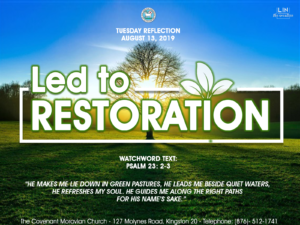
Led to Restoration

Psalm 23: 2 – 3

The journey of the Moravian remnants to the rebirth of the Moravian Church on August 13, 1754, can be described in the words of David in Psalm 23: 2 & 3. ‘He makes me lie down in green pastures; he leads me beside still waters; he restores my soul.’ Persecuted for their faith, the brethren were scattered and almost lost forever. As this was happening, John Amos Comenius, the last Bishop of the old Unity of the Brethren, prayed that the Lord would preserve a remnant of the church. His prayer was answered almost a hundred years later when Christian David was given permission by Count Zinzendorf to bring any persecuted member of the church he could find to stay on his estate in Germany where they would be safe from persecution. For these persecuted brethren God was truly leading them from turmoil, hardship, persecution and even death, to a place of restoration, a place of green pastures and still waters. David used the shepherd imagery to describe God’s complete provision for His servants. As the shepherd led the sheep daily to green grass, calm water and shade, the sheep would find satisfaction and restoration. Christian David had been a shepherd himself so he understood the imagery of the Psalm. God would lead his people from trouble, fear and turmoil, to restoration. Christian David made trips into the areas where the remnants of the Moravian Church were to be found and led them to the estate of Count Zinzendorf where they were restored and renewed.

All was not well however as the new settlement was anything but settled. There were frequent disagreements and they were helped by Zinzendorf to unite under a common understanding of their faith. They agreed to, and signed the Brotherly Agreement, (known today as the Moravian Covenant for Christian Living) a code for Christian conduct, and it was agreed that they would celebrate this milestone with a communion service on August 13, 1727. They gathered with a common purpose, united in prayer. As they worshipped the Holy Spirit filled their hearts with love for God and for each other and out of that experience the Moravian Church was reborn. God had led His people through the valley of the shadow of death, through persecution, wars and hardships to a place where they could worship in peace and safety, a place of restoration.

As we celebrate today I would like to assure someone that God still restores and renews. You may be in the valley of death and despair but that is not your destination. Do not get comfortable in despair for God is leading you to your place of restoration and renewal. Remember the woman with the issue of blood was healed and restored when she touched the hem of Jesus’ garment. Remember the blind and deaf found new life when Jesus entered their situation. Remember Lazarus was dead bur Jesus called him forth from the tomb. Nothing is too hard for our God. Whatever your situation may be, He is able to bring restoration. Do not give up. Do not turn away. Let God lead you friend so that God can restore you.

Bevon White

Monday Reflection – August 12, 2019

Let’s Sing!


They sang responsively, praising and giving thanks to the Lord, “For he is good, for his steadfast love endures forever toward Israel.” And all the people responded with a great shout when they praised the Lord, because the foundation of the house of the Lord was laid.       Ezra 3:11

The book of Ezra opens with the end of the Babylonian captivity and the return of the exiles to Jerusalem. For some time after their arrival they were occupied with the necessary work of rebuilding their houses and lives, amid the ruins of Jerusalem and its neighborhood. Having accomplished this, they sought to rebuild the altar of burnt offering. This was urgent and immediate so they could make atonement for their sins and receive the divine blessing on their preparations for the temple.

As they set out to rebuild the temple, they organized the base upon its old foundation, so that it occupied as nearly as possible the site on which it had formerly stood.  There they offered the burnt offerings, as they wanted to restore their religious and worship life even before the temple was rebuilt and dedicated. At the establishment of the foundation, the faith community began to worship God. They sounded the trumpets and cymbals as they sang and shouted, praising and giving thanks to God. They declared, ‘God is good and his mercy endures forever toward Israel.’ There were no walls, no roof, no pulpit or table, yet they worshipped God. Isn’t it true that sometimes we get caught up in the beautiful edifice that we lose sight of the worship? Sometimes our focus is on the sanctuary more than the worship? I am in no way suggesting that we ought not to ensure that God’s temple is in an appropriate state. However, our focus should be more on the quality of worship to God.

It is interesting that there was a mixed reaction from the people when they saw the foundation of the temple built. Some shouted for joy, while others wept. In fact, verse 13 says that one could discern the shout of joy from the noise of the weeping. Those who had only known the misery of having no temple at all, praised the Lord with shouts of joy. For them, it was as life from the dead. However, many who had seen the first temple were distressed that this new temple is likely to prove far inferior to that of the first, not only with regards to its outward structure, but also relating to the extraordinary marks of the divine favour that were evident in the first.


There was no hope that the poor beginnings of the latter temple would ever be raised to the grandeur and magnificence of the former, since the first was built by Solomon, the wisest and richest king. However, this new temple was being pursued by a small company of exiles. The first was finished with the most costly stones and timber, with exquisite art and overlaid with vast quantities of gold, while this one was going to be built with no better materials than what could be dug from the ruinous foundation of the old one.


Perhaps the greatest source of grief was that the ark of the covenant, and the mercy- seat which was upon it, the holy fire upon the altar, the Urim and Thummim, the spirit of prophecy, the Shekinah or divine presence, the five great things for which the former temple was so renowned, were lost and gone, and never to be recovered. What a time of distress for many! But, God provided a word through the prophet Haggai, “I will shake all nations, and the desire of all nations shall come; and I will fill this house with glory: the glory of this latter house shall be greater than of the former, says the Lord of hosts.” (2:7-9) Let us not stay consumed with the past and weep over it. Instead, let’s open our mouths and sing for joy; open our eyes and look, for God is going to do something new and better!

Jermaine Gibson

Thursday Reflection (August 8, 2019) – Omnipotent God

Omnipotent God

 
In your hand are power and might, so that no one is able to withstand you. 2 Chronicles 20:6
What do you do in times of difficulty and fear? I can tell you what King Jehoshaphat did. Three nations joined forces to fight against Judah. So large was this army that a messenger to the King referred to the army as, “A great multitude.” The scripture tells us in verse 3 “Jehoshaphat was afraid;  so he set himself to seek the Lord, and proclaimed a fast throughout all Judah. The following verse tells us, “Judah assembled to seek help from the Lord; from all the towns of Judah they came to seek the Lord.”
It is here in a prayer Jehoshaphat declared, “In your hand are power and might, so that no one is able to withstand you.”
We can learn from Jehoshaphat how to deal with situations of fear, anxiety, and attacks from the enemy; we fast and pray.
We do so with confidence, because of the declaration made by the King. In God’s hand is power and might. What a mighty God we serve. Jehoshaphat declare the might of the Lord. It was God who brought them into the Promised Land and defeated their enemies.
Similarly, we too are well acquainted with the might and power of God.
I share a few of mine:
It was God who healed me from severe stomach pain as a child when doctors could not diagnose the problem.
It was God who saved my life when a gunman entered my community to kill someone who insulted his cousin (not me).
It was God who provided money to fix my car when the engine needed to be replaced.
The testimonies are many of God’s might and power. When we are afraid and overcome by the challenges of life we MUST REMEMBER God is Omnipotent- All powerful.
 There is no one as mighty as God. God has proven himself time and time again. Just by looking at nature, we can see the power  and might of God.
Because of his great might and power; no one can withstand Him. No situation or person is too big for God. So even though a multitude come against us, my God, our God is mightier.
Until next week rest assured of the might and power of God.
Christopher Euphfa

Wednesday Reflection (August 07, 2019) – O Bethlehem of Ephrathah!

But you, O Bethlehem of Ephrathah, who are one of the little clans of Judah, from you shall come forth for me one who is to rule in Israel, whose origin is from of old, from ancient days. Micah 5:2


Today’s Watchword is one of the many prophecies that pointed to the coming Messiah. This prophecy comes at a time when trouble loomed in Israel. Micah summons the people to gather themselves into troops because a siege will be laid against them. Israel will be humbled by foreign powers, and even her judges will bear insults. In this distressing context, Micah offers a word of hope – God would raise up a great Ruler from the humble place of Bethlehem.

Bethlehem was well known as the hometown of David, Israel’s greatest king; yet it was never a great or influential city. It was truly little among the thousands of Israel. Yet, God chose it as the birthplace of the Messiah, the Ruler in Israel. The chief priests and teachers of the law quoted this verse when Herod asked about the birth of the Messiah (Matthew 2:5-6). It is no wonder that Phillips Brooks wrote in 1868:

O little town of Bethlehem,
How still we see thee lie!
Above thy deep and dreamless sleep
The silent stars go by;
Yet in the dark street shineth
The everlasting Light;
The hopes and fears of all the years
Are met in thee tonight.

Bethlehem means ‘House of Bread’, and Jesus is the Bread of Life (John 6:35). Ephrathah was the old name of the place which the Jews retained and loved. It means ‘fruitfulness,’ or ‘abundance.’ Well, well!! Jesus was born not just in the house of bread, but in the house of fruitfulness. This seems almost like a paradox – Bethlehem was an insignificant place, yet its meaning is rich and bountiful. What a word for a people about to face trouble! You will face trouble, but God will bring forth a ruler from the place of food and abundance to deliver you.

Micah is careful to point out that this ruler did not just come about; in fact, his ‘…origin is from of old, from ancient days.’ The Ruler, the Messiah, did not begin in Bethlehem. His going forth is from eternity past. Revelation 22:13 points out that Jesus is the Alpha and the Omega, the Beginning and the End. He was from the very beginning. Indeed, the Messiah did come – promised fulfilled!! Yet another of God’s fulfilled promises to us. We can rest assured that whatever God says he will do, he will most certainly deliver on his word.

The Messiah came not just to rescue the Israelites, but to rescue and save all humanity from the forces of men and the armies of satan. He came, procured our salvation, and guarantee us life everlasting. May we receive God’s gift to us and live with eternity in view. May we also recognize that no matter how insignificant we think we are, God has vested much in us and prepared to do great things in and with us.

Jermaine Gibson

Monday Reflection (August 5, 2019) – Our Father and Potter


Our Father and Potter

 Yet, O Lord, you are our Father; we are the clay, and you are our potter; we are all the work of your hand. Isaiah 64:8

How do we view God? More than that, how do we view God in relation to ourselves? The Bible describes this relation in varying ways, including today’s text that declares God as the potter and his people as the clay. This description is also present in other texts in the Bible. Isaiah 64 is a prayer of appeal to God to exercise mercy in the presence of the sins of the people. Isaiah begins with, “O that you would tear open the heavens and come down, so that the mountains would quake at your presence… so that the nations might tremble at your presence! …From ages past no one has heard, no ear has perceived, no eye has seen any God besides you, who works for those who wait for him.”

It is in this context that we have today’s Watchword declaring God as Father and potter, and us as clay and the work of God’s hand. In spite of everything, God is our Father. God might be disappointed with our behaviour; God might have allowed us to engage in self-destructive behaviour; God might have allowed us to do our own thing, but God’s purpose has never been our destruction. God’s hope is the hope of a Father, who always hopes against hope that the child will see the error of his/her ways and return home. The Parable of the Prodigal Son in St. Luke 15 is a prime example of this.

God is also our potter – the one who fashions us. We are clay and the work of his hand. Just as fathers and mothers love their children, artists also feel a deep affection for their art. When an artist fashions a piece of art, something of the artist is bound up in that art. Part of that has to do with the deep involvement of the artist in the creative process. Part of it is pride of workmanship. Part of it is that the work of art reflects the artist’s understanding of how the piece should look or sound or feel. The artist and the art are inextricably bound together. God has invested much time in us; indeed God has invested himself. He is bounded to us as our potter who desires that we be an excellently admirable art piece of his work.

This prayer uses that connection of art and artist in an attempt to persuade God to forgive Israel, to save Israel. Having called God a Father, Isaiah reminds God of the creativity that God has expended in fashioning the nation Israel—God’s people—God’s artwork. Israel might have sinned, and be as disgusting as a soiled filthy rag, but God should not abandon Israel, because artist and art are inextricably bound together. It is always God’s intention to fashion us into the best that we can be; however, we should remember that a potter can mold a vessel only as the clay yields to his hands. We have such great potential, but this can only be optimized when we submit to God, our potter, and remain in his molding hands.

I close with today’s New Testament text from Ephesians 2:10, “For we are what he has made us, created in Christ Jesus for good works.” 

Jermaine Gibson